

AEB Is Becoming the Norm: How to Evaluate Safety Tech on a Used Car
If you’ve shopped for a used car lately, you’ve probably seen the same buzzwords over and over: AEB, FCW, Lane Assist, Adaptive Cruise, Blind Spot… and suddenly you’re 12 tabs deep wondering what actually matters.
Here’s the good news: you don’t need to become an engineer to shop smarter. With a simple, repeatable approach, you can confirm the most important safety tech on a used car in about 10 minutes—and feel confident you’re comparing apples to apples.
And yes—there’s a reason this is everywhere right now. Federal standards and safety-rating updates are pushing AEB and other driver-assist features into the spotlight.¹ ²
First, what AEB actually does
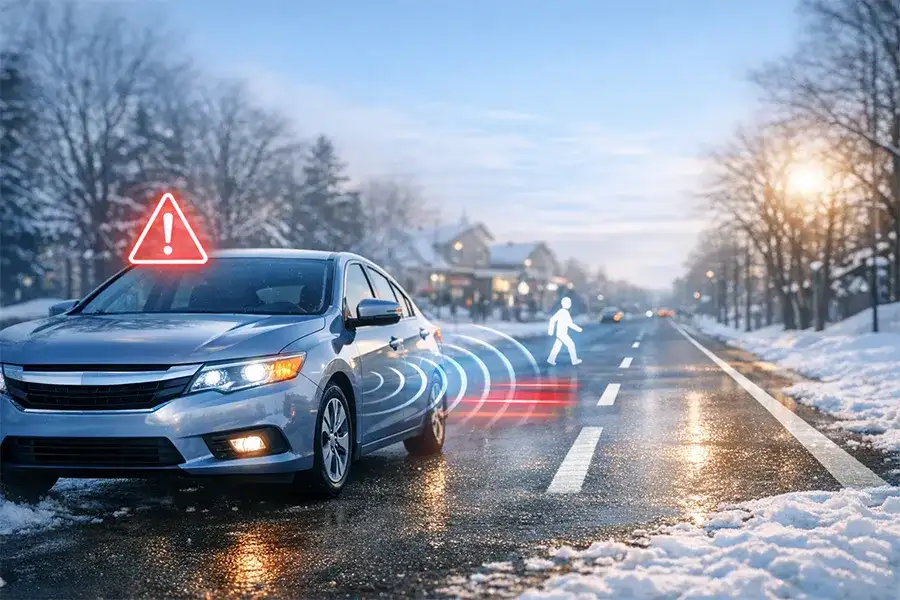
Automatic Emergency Braking (AEB) is designed to help reduce or prevent a front-end crash by automatically braking if a collision appears likely and the driver doesn’t respond in time.
Think of the kind of everyday moments we all have—traffic compressing on I-93, a quick stoplight change on Loudon Road, or someone braking suddenly as you’re rolling through downtown. AEB is meant to help in those “it happened fast” situations—not replace attentive driving.
The 60-second glossary
- FCW = Forward Collision Warning (alerts you)
- AEB = Automatic Emergency Braking (can brake automatically)
- PAEB = Pedestrian AEB (helps detect pedestrians; varies by system)
- BSW = Blind Spot Warning (alerts you)
- LKA = Lane Keeping Assist (helps steer to keep you centered)
- ACC = Adaptive Cruise Control (maintains speed + following distance)
Tip: brands give these features different marketing names. When you’re shopping, focus on the function (AEB/FCW/BSW/LKA), not the catchy label.
A simple 3-layer way to shop
Layer 1: Must-haves for most drivers
These are the features that tend to offer the most real-world value for everyday driving:
- FCW + AEB
Layer 2: High-value upgrades
If your budget allows, these often feel like meaningful step-ups:
- Blind Spot Warning
- Lane Keeping Assist
- Pedestrian AEB (when available)
Layer 3: Convenience features that can be great
These can make commuting easier, especially on longer stretches like I-89, but they’re not required for a smart purchase:
- Adaptive Cruise Control
- 360° camera
- Parking sensors
The 10-minute used-car safety tech check
Step 1: Confirm what the car is supposed to have
Because trims/packages vary, start with one of these:
- Window sticker / build sheet (best)
- A dealer-provided features list by VIN
- The original listing’s “features” section (verify it in Steps 2–3)
Step 2: Verify it in the vehicle settings menus
With the car on, look in the driver-assist menus for:
- Forward Collision Warning
- Automatic Emergency Braking
- Lane features (Lane Keep / Lane Departure)
- Blind spot features
If the settings aren’t present, that’s a clue the car may not have the feature—or it may require a package/trim you’re not looking at.
Step 3: Do a quick hardware check
You’re not diagnosing—just confirming the car appears equipped.
Look for:
- A camera housing near the rearview mirror (common for lane/collision features)
- A radar area in the grille/emblem region (varies by make/model)
Red flags:
- Cracked windshield near the camera area
- Front bumper damage/misalignment right where radar might sit
- Warning messages on the dash about sensors/cameras
Step 4: Take a safe test drive
Don’t try to force AEB to trigger (unsafe and unpredictable).
Instead, look for normal signs the system is alive:
- You can turn FCW/AEB on/off in settings
- Alerts behave normally (no persistent error lights)
- Lane markings are detected when conditions allow (if equipped)
Step 5: Check recalls by VIN
Before you commit, run a VIN recall check. It’s quick and worth it.³
Why do AEB systems feel different from car to car?
Because AEB performance isn’t identical across models and years, and testing keeps getting tougher. The Insurance Institute for Highway Safety (IIHS), for example, has been evaluating updated front crash prevention performance in more demanding scenarios—showing meaningful differences between vehicles.⁴ ⁵
Bottom line: “has AEB” is a starting point. Verifying what’s included (and that it’s working normally) is the smart move.
Used-car reality: the two questions that prevent most surprises
1) “Is it standard, or was it optional?”
Two identical-looking cars can be totally different depending on trim/package.
2) “Has the car had repairs that could affect sensors?”
Driver-assist tech can be affected by:
- Windshield replacement
- Front bumper work
- Alignments/suspension work after impacts
- Collision repairs
That doesn’t mean “don’t buy it.” It means you should confirm everything is operating normally and, if needed, have the system checked.
Winter tip for New Hampshire drivers
Snow, slush, and road grime can block sensors. If you’re driving after a storm or through messy spray on roads like Storrs Street, it’s normal for some systems to temporarily disable until sensors are cleared.
Quick habit: keep the camera/radar areas clean when you clear your windshield and headlights.
Want help verifying safety features on a specific used car?
At Nucar Pre-Owned Superstore of Concord (13 Manchester Street), we can help you compare trims and confirm which driver-assist features are actually on the vehicle you’re considering—so you don’t have to decode it alone.
And if you’re shopping across the Nucar Network in New England, our site notes we can help coordinate bringing a vehicle to Concord for a convenient local look
Everyone loves a Nucar!
Footnotes / Sources
¹ NHTSA press release on FMVSS No. 127 (AEB + pedestrian AEB becoming standard by September 2029): https://www.nhtsa.gov/press-releases/nhtsa-fmvss-127-automatic-emergency-braking-reduce-crashes
² NHTSA NCAP delay notice (program updates postponed one model year, to MY 2027): https://www.federalregister.gov/documents/2025/09/22/2025-18285/new-car-assessment-program-ncap-notice-delay-of-program-updates
³ NHTSA recall lookup (VIN-based): https://www.nhtsa.gov/recalls
⁴ IIHS update on tougher front crash prevention evaluation and results: https://www.iihs.org/news/detail/automakers-make-big-strides-in-front-crash-prevention
⁵ Consumer Reports discussion of newer IIHS testing and AEB performance variability: https://www.consumerreports.org/cars/car-safety/how-well-do-new-cars-avoid-front-collisions-a8584688455/
0 comment(s) so far on AEB Is Becoming the Norm: How to Evaluate Safety Tech on a Used Car